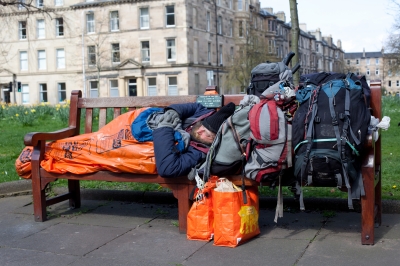
Why would someone choose to be homeless?
There is no one answer to this question. Each person you ask would see their world a little bit differently and give a unique response. The plethora of answers include but are not limited to: drugs, laziness, learned helplessness, victimization, and economic hardship. For many, being homeless is not a matter of choice, but rather a fact of life.
According to the Substance Abuse and Mental Health Services Administration, 20 to 25% of the homeless population in the United States suffers from some form of severe mental illness (SMI). In comparison, only 6% of Americans are severely mentally ill (National Institute of Mental Health, 2009).
Upon researching different forms of SMI, one will quickly discover that most have one thing in common; they impair a person’s ability to complete their basic daily functions. Gainful employment is often impaired by symptoms, and although some will receive disability benefits; others may fall through the cracks and not know about disability or be too symptomatic to apply. If one cannot complete the basic daily functions such as showering or remembering to eat three meals, how are they supposed to have self-awareness to go out and get access to the programs and services designed to help them survive? Without these programs they lack the basic necessities of a roof over their head, food in their mouths, and reliable medical care.
Food in the life of a homeless person comes from wherever it is available. More important than where the food comes from is what, if any nutritional value. In a society rampant with easy access to junk food, unhealthy foods are much more prominent. Chronic hunger results in getting food to fulfill the need as fast as possible, regardless of what it is. The nutrients that food provides to the brain are key in a chemically balanced person, and critical in a chemically imbalanced person.
If someone cannot regularly access healthy food, they likely don’t receive necessary medical attention or have a reliable place to store their prescribed medications so critical for treatment. Without storage, they are exposed to thieves who take the medication, expiration of the medication when it is not kept in the proper climate, the appeal of selling their medication to have money, or the desire to not take the medication because of the side effects or not believing they have an illness, called anasognosia. All of these realities disturb the normal routine that is fundamental for the medication to be effective. Now, you have an equation of food as an irregular resource that is key for survival, medication that is ineffective without regular dosage, and perhaps most importantly nowhere to rest at night. Irregular sleep is unhealthy and can be a trigger for many symptoms.
Without a secure place to live, homeless must sleep wherever they can. This may include but is not limited to, a local abandoned business building, a park bench, or a local homeless camp. All of these have one thing in common, they are temporary. It is only a matter of time before the public outcry forces police to do something about these types of places. Remember the mental stability piece of the equation as police repeatedly go to these “camps” and warn people that they will be forced to clear the area on a certain date. The likelihood of a. remembering the date, or b. cognitively recognizing what the warning actually means, is little to none. When the day comes that they are kicked out, the question becomes where to go next. The underlying problem is that the cycle is merely starting over, there is no resolution. Sure, one area is clear, but another will quickly pop up as the next makeshift home.
Is there a way to “fix” homelessness?
Although there is not one simple fix, there is a viable starting place. Enter the idea of therapeutic treatment that is based on lasting recovery, rather than temporarily assisting someone to reach a level of stability while still on the street. If one goes from homelessness to entering a care facility, with access to the right tools to treat their diagnosis and teach them how to live with their diagnosis and complete daily tasks they are capable of, then you have a recipe for success.
Providing a systematic way out of homelessness has proven to be very successful. The idea of housing first, or getting someone into a stable place to live right away, and then helping them to get other resources such as access to medical care allows for a better chance at getting back on your feet for the long term; rather than being placed in a temporary situation with a high risk that things will go back to the way they were, resulting in being homeless once again. Often times, a transitional residential program is one of the first steps to teaching life skills to help a person on to a path of recovery and individualized level of achievement for everlasting change, that may very well prevent them from being homeless again.
 ForeverWell