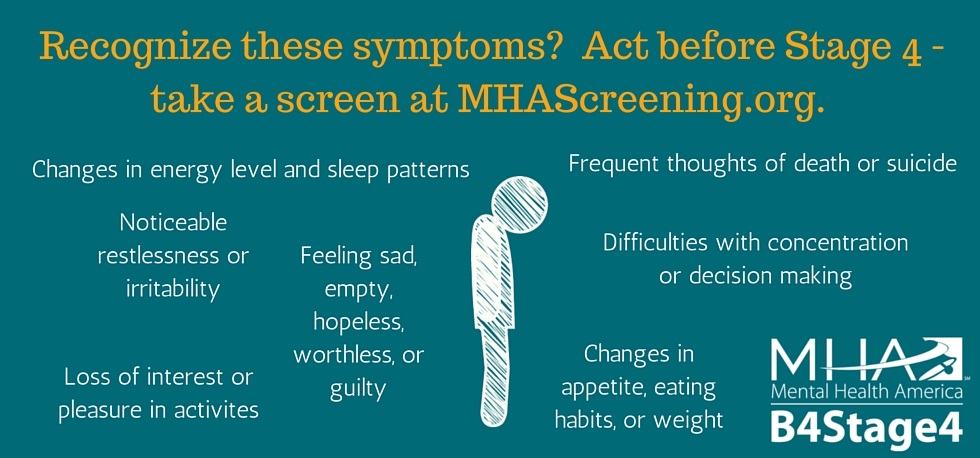
Mental Health Screenings

Depression Screen pic 5.20..jpg
Image Courtesy of: Mental Health America 

When it comes to mental health, the first step is elusive for many when speculating that there may be problems developing for themselves. What to do?

It is recommended to go to the family doctor to talk about any issues or feelings that are troublesome. Some symptoms may be medical related, so it is always best to go to your doctor and include them in your recovery journey. The doctor will have guidance on where to begin in the search for treatment.

There are several other sources to augment what the doctor says. For example, in the case of those that want to do self-exploration, and may find it difficult to initially speak to their doctor, or don’t have a current doctor, there are other options.

Nationwide many health related organizations have available tools. One such organization is Mental Health America (MHA). Their Mental Health Screening link is found here.

Follow the information on the page. Resources and suggestions are included. The results of the screening test may rule, in or out, a mental health challenge.

If doing an internet search, “Mental Health Assessment,” and the “name of your town” will bring up local resources, government mental health services, or the recently implemented retail pharmacy treatment centers.

A recent important article related to May being Mental Health Month, is “Walgreens hopes to screen 3 million on mental health by next year” announces that local pharmacies will soon be providing screenings.

Considering the month of May is Mental Health Month, it is a good time to inquire about a screening. Many organizations, local, state, and federal departments are focused on awareness to the public in May and encouraging those interested to take the first step!

Standing in the Way of One’s Own Help

Road Block

There are just about as many ways to get help, as there are methods of help. All of these are need based, and the need is determined at the hands of someone else. Author Todd Essig’s articleHelp for Consumers Shopping the Confusing Online Mental Health Marketplace” written for forbes.com, discusses the complications with relying on online help. The two issues raised in this article are: “There is neither adequate assessment nor professional accountability.” These issues are not only present in the online help platforms available, but also in real life, as people who face mental illness inadvertently stand in their own way.

When it comes to online help, there is no limitation to where a therapist can hold their practice. Without respective boarders, any insurance or protective measures cannot be controlled. Essig illustrates this point in saying “But for now, adequate professional accountability for potentially unethical actions is lacking.” While a therapist may carry good insurance, the insurance is typically only regionally applicable. While regulations and requirements for online treatment are being developed as the process becomes more commonly practiced, there are far too many holes and gray areas to fully ensure that a therapist will be held accountable through a broadly applied online platform.

Unethical action can sometimes be intentional, although it can also be the result of error. In the case of virtual treatment; it may be as simple as a misunderstanding of the patient’s symptoms, or worse, a result of the fact that people can easily edit themselves. Author Joe Madden hits the nail on the head in his article “I tried to Fix my Mental Health on the Internet” when saying “The fact that you can edit messages before sending them means you’re unlikely to blurt out something unguarded and revealing in the heat of the moment.” While online, the editing is in the form of messages, in person, the editing is in the form of personal character. This “editing” is what often makes people their own roadblock from getting adequate help.

When someone decompensates, or has a complete breakdown and loses the ability to control their psychological and physical functions, it is an ultimate low point. They are most certainly not themselves. The typical process is for them to go to the local ER and be assessed. Upon completion of an assessment, they are either sent away with a suggestion to see an outpatient psychiatrist, or admitted to the hospital’s psychiatric department. It is a very different situation if the person does not want help, and a friend, family member, or someone nearby calls 911 for help. The police can utilize a law referred to as 5150 to bring the unstable person to certain psychiatric facilities that have a license for evaluations.  Once a doctor has assessed the patient, they can be admitted with or without their consent on a 72-hour hold. During that time, they are monitored by trained staff, medications may be administered to assist them in regaining stability, and ultimately a plan is put into motion for what will happen after their time in the hospital is up. This is a process that is evidence based and  has been vetted over years of law and regulation development.

With online treatment the person is self determining the severity of their situation, and making decisions on how to be assessed and treated. The instability of an emergency situation can be very dangerous time for self-assessment as perception of reality is very skewed, and clear thinking is essentially impossible. If one is not facing an emergency when seeking online help, they still have the  capability to edit themselves. Editing means censoring their actions and mannerisms before they respond to the online service. The virtual treatment censorship is a two way street, in that the doctor can also sensor themselves and act outside their scope of knowledge. An online atmosphere removes the in person capacity to monitor the patient in real time, and treat them with adaptable evidence based skills.

On one hand, the problem of professional accountability lies more in the hands of virtual treatment that can be complicated waters to navigate on the internet. Debates on regulation and licensing for online services are being developed. On the other hand, the problem of continual assessment applies to both virtual and in person treatment. Self editing and censorship of one’s behaviors presents a huge problem, when the resulting treatment becomes based upon the façade, rather that true reality. Skewed treatment may result in the person being denied access to evidence based programs designed to help them get stable and have long term success in their life.

The above referenced articles evaluate the advantages and dis-advantages of online treatment, while acknowledging that rules and regulations for online help are being developed currently. This presents a buyer beware market. The person seeking help would be wise to explore in person treatment as well online treatment. The severity of their condition should be one of the final determinants of the type of treatment to seek out. It is essential to remember that mental illness is not a one size fits all.The goal should always be to make sure every person who faces a mental illness receives the best possible care for their specific situation.
Alano Club Modesto Event

circle-159252_1280

One of the greatest assets an individual can have in their journey through life is community. A sense of communion or belonging amongst one’s peers allows for simultaneous comfort and growth; as an individual finds their sense of self and develops the realization that they are not alone in the world. Often times, a community of people is based around similar interest or experiences. Having the relatable experiences be positive is a great thing, although it is when the experiences are negative that relatability becomes critical. Whether it be out of fear, embarrassment, or a range of other emotions, people don’t often want to come right out and talk about negative experiences. Having others who have gone through something similar allows one to see not only tangibly see success within other people’s lives, but also to subconsciously start to envision themselves adapting to those same successes in their life.

Two types of experiences specifically related to Ever Well Health Integrated Health Care are substance use issues, and mental illness. There is something to be said for pure relatability amongst people who have shared similar experiences in both of these areas. It is in places such as modern therapeutic treatment communities and Alano clubs that healing and growth are provided within a community setting.

The Alano Club of Modesto has been providing a place for people to go and commune for more than 40 years. In this month’s Stanislaus Magazine, John Black, of the Peer Arts Recovery Project says: “The Club’s managers believe in maintaining its roots as a haven for those who need it as well as a gathering spot for those who want to remain sober and enjoy some great company.” (page 43). All of these gatherings are organized through the efforts of wonderful volunteers. While the club does have a small membership fee, they rely for the majority on donations and fundraisers to be able to cover basic expenses and keep their doors open.

Ever Well is proud to partner with the Peer Art Recovery Project, to host a benefit for the Alano Club of Modesto. The April 16th event aims to provide a night of socializing for community members, while raising funds for a great cause.

What is the relationship between the Alano Club as a sober environment to someone who faces a mental illness?

There is typically a large connection between mental illness and substance abuse as people facing these issues fall on hard times and turn to a variety of sources for escape and comfort. This reaction is not always the case, although it is always the case that places like the Alano Club that allow for people to thrive. Just like kids like to join sports teams with their friends, or adults join things such as book clubs, people who face mental illness, or have substance use issues alike need a place to convene to socialize and celebrate their accomplishments. The Alano club offers this space with people who have had similar experiences in their lives. As John mentions in his article, people who previously turned to alcohol or drugs to escape or celebrate, now have a way to celebrate their accomplishments in a safe, sober place.

As people spend time at Ever Well getting the tools they need to build a stable life, it is important for their program activities to include introductions to places such as wellness centers and Alano clubs so that wherever that person may end up, they will know how to reach out to develop a community to be continually reminded that they are not alone. The sense of belonging and comfort astronomically improves one’s chances of staying on a clean stable path to have a great life. We at Ever Well value the opportunity to support an organizations like the Modesto Alano Club and The Peer Arts Recovery Project to ensure the gift of community and sobriety for many years to come.

If you or someone you know is facing a mental illness or substance use issue in Central California, please contact the Peer & Family Advocate at: (209) 543-2425

To support recovery efforts in the Central Valley click here.